What is Critical Power and W Prime (W’) and how do I use them?
This post was written by Tony Pilborg of Topway Coaching. Tony also created all the training plans and workouts for Cadence. Make sure to reach out if you’re looking to increase your performance with personalized coaching.
Understanding Your “Internal Battery”: A Guide to W’ and W’bal
Ever wondered why you can hold a specific high power for exactly two minutes before your legs seize up? Or why some riders can “recover” mid-race while others can’t? The answer lies in a physiological model called W’ (W-prime) and its real-time status, W’bal.
What is W’?
W’ is the finite amount of work you can perform above your Critical Power (CP). Think of it as a battery or a fuel tank containing a specific amount of high-intensity energy (measured in Joules).
The Relationship: CP vs. FTP
To use this model, we first need to define the “drain point.”
- Critical Power (CP): This is the mathematical threshold where you shift from sustainable aerobic effort to depleting your finite reserves (W’).
- The FTP Connection: While technically different (CP is usually slightly higher than FTP), they are practically interchangeable for most users. If you don’t know your exact CP, using your FTP as the baseline is a highly effective way to start using the model in the real world.
Why the W’ Model Works
The model is effective because it treats your high-intensity capacity as a fixed bucket of energy.
When you ride below CP, your “bucket” stays full. The moment you exceed CP, you start pouring energy out of that bucket. The higher the intensity, the larger the “hole” in the bucket, and the faster the energy drains.
The beauty of the W’bal (W’-balance) model is that it also accounts for recovery. When you drop back below CP, the model calculates how fast your body “refills” that bucket, which is a non-linear process depending on how far below CP you are riding.
How to Use W’bal in Cadence
Cadence now features a real-time W’bal tracker and “Time to Depletion” and “Time to recover” metrics. Here is how to interpret them:
- Managing the “Battery” (Real-time W’bal)
This is your current fuel level. If your W’ is 20,000 Joules, and your W’bal shows 10,000, you have exactly half of your “matchbook” left to burn. This helps you decide: “Can I afford to bridge this gap, or will I blow up before I get there?” - Time to Depletion: “The Death Timer”
The app now shows: “At this effort, the battery will be depleted in XX seconds.”- In Training: Use this to pace your intervals. If your interval is 4 minutes long, perhaps you want your W’bal to hit near-zero right as the timer ends. Or more likely, you have repeated intervals, and after the first interval you might end with 25% left, after the second interval it could be only 10%… Perhaps completing 4 intervals will be impossible at that intensity and recovery period.
- In Racing/Climbing: If you see “Depletion in 20s” but the top of the hill is 40 seconds away, you are over-pacing. Dial back immediately to extend your remaining energy.
- Mastering Recovery
By watching your W’bal climb back up during a descent or while drafting – or by looking at the W’ Balance: Recovery Time (W’ recovery time to 95%), you can see exactly when you are “ready” to go again. It takes the guesswork out of whether you have recovered enough for the next attack. The recovery is not linear, it depends on the “state of charge” and how far below CP you are performing—and thus the last few percents can take quite some time.
How to find your CP and W’
Critical Power (CP) is closely related to your Maximum Metabolic Steady State. It represents the upper limit of your aerobic engine. This is the level at which you can still clear lactate, and thus not blow up within minutes. It is the size of your aerobic engine. When going above CP, you start to utilize anaerobic energy systems on top of the aerobic energy.
To establish your CP and W’ you can measure you best efforts at different time intervals. Often athletes use 3 minutes and 12 minutes, but in reality any short intervals (2 or more) can be used—and fitting a curve to these points (time and energy produced in that time) can give you CP and W’.
While such simple models suggest you can produce infinite power for infinitely short durations, we know that’s not the case. This is why more advanced models (like Morton’s 3- point) include your 5s or 1s maximum power.
In reality, most users use online tools, like intervals.icu, to determine CP and W’ based on historical performance. I can only recommend using intervals.icu, since it is also beautifully integrating Training Plans and Workout synchronization with Cadence.
How to adjust when you “break” the model
If your W’bal drops below zero during an all-out effort, you have officially leveled up. However, deciding whether to increase your CP or your W’ depends on how you broke the model.
If your longer efforts have improved (more than the very short efforts), then most likely your CP has increased.
If the longer efforts are as hard as before, but you can stay at very high power outputs for longer—the punchy 1 minute or 3 minute efforts—then most likely you should increase W’
Advice: It could be argued, that if you believe there is a barrier, you are less likely to outperform it. So if you are using W’bal—both in training and during races—make sure to establish that going below 0 is NOT a barrier that can’t be passed, but a challenge for you to prove that you can pass!
Do not let a number in Cadence limit your ambition or performance. If you’re feeling great and the app shows 0%, keep pushing—you’re just busy redefining your limits and “leveling up” your profile.
Summary
- W’: Your total high-intensity energy reserve (The size of the battery).
- W’bal: Your remaining anaerobic energy at this exact moment.
- CP: The “tipping point” (Use your FTP as a practical proxy).
Limitations of these tools
This model is very accurate and effective. But it has a few challenges.
When you are creating power through anaerobic processes, the body is actually utilizing two distinct energy systems on top of your aerobic energy production.
PCr (Phosphocreatine) – The “Instant Battery”: This system provides immediate energy for high-intensity bursts (like a sprint or a sudden jump). It is very powerful but extremely limited, typically lasting only 5–10 seconds. It recharges relatively quickly when you drop below CP.
Glycolytic (Anaerobic Glycolysis) – The “Lactic Engine”: This system breaks down glucose without oxygen to produce energy. It is the primary driver for hard efforts lasting from 30 seconds up to several minutes. While it has a larger capacity than PCr, it produces metabolic byproducts (like hydrogen ions) that lead to the “burn” and eventually force you to slow down.
In summary: PCr gives you the explosive “snap,” while the Glycolytic system gives you the “sustained punch” above CP. Both contribute to your total W’, but they recover at different rates, and the model doesn’t take that in to account.
The other issue is, that even though the model suggest that your battery can be recharged to 100% by going below CP, reality is that fatigue will set in at some point. So after spending large amount of Kj of metabolic energy, your effective W’ (and likewise also CP) will be reduced. How much reduced, and whether it is mostly CP or mostly W’ that is reduced (and also maximum power) will depend on the type of effort, the type of athlete, etc.
Total energy expenditure as well as energy above CP are all factors. So is individual training level and athlete type.
Dynamic CP/W’: Adjusting the Model During the Ride
Cadence supports Dynamic CP/W’ through the setting “Adjust CP and W’ during recording.” When enabled, the app can gradually adjust your effective CP and W’ while you ride, based on the fatigue you accumulate. In other words, the model does not have to assume that your “battery size” and “drain point” remain perfectly fixed from the first minute of the ride to the last.
This is controlled with an on/off switch for Dynamic CP/W’, and a separate setting called Dynamic Durability Level, which determines how strongly CP and W’ are adjusted as fatigue builds up. A higher durability level means the model assumes you are better able to preserve your CP and W’ during long or hard rides, while a lower durability level means the model will reduce them more aggressively as fatigue accumulates. This can make the W’bal model more realistic during longer rides, races, or repeated high-intensity efforts, where your effective performance capacity is rarely identical at the beginning and at the end of the ride.
It is important to remember that this is not an exact science. The model is based on physiology and power data, and in practice it can be very accurate, but every athlete responds differently to fatigue. Because of that, the parameters behind the dynamic model may be adjusted slightly over time as more data and experience become available.
Reviewing W’bal After the Ride
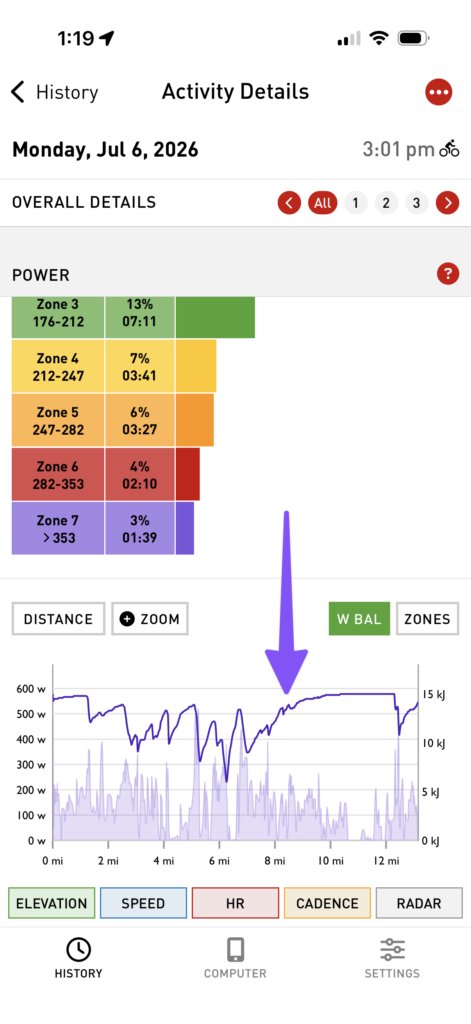
After a ride, Cadence also lets you review how your W’bal developed throughout the activity. In the power graphs, you can see the W’bal curve for the entire ride, giving you a clear picture of when you were spending your high-intensity energy, when you were recovering, and how deeply you drained the “battery” during the hardest parts of the ride.
You can also inspect this for individual laps. This makes it especially useful for intervals, climbs, race segments, or repeated efforts, where you may want to compare how much W’ you used in each lap and how well you recovered between them. One of the most useful values to look at is the lowest W’bal point during the ride or lap—the moment where the battery was most depleted. This can help you understand whether you paced an effort well, whether you reached your limit, or whether you still had some high-intensity capacity left at the end.